A story about a timely matter
22, October 2026
⁂
On Monday, October 5, Christa Pike had not woken. She lay on a ventilator in a Nashville hospital, both arms swollen, burned, and blistered, while doctors worked to clear the pentobarbital from her blood. In 1995, at eighteen, she tortured and killed Colleen Slemmer, a fellow student at the Job Corps Center in Knoxville. Five days earlier the State of Tennessee administered not one, but two doses of pentobarbital in an attempt to kill her for it. She survived both of them. Unconscious, but alive.
⁂
In 1983, a caseworker in Winnebago County, Wisconsin, made monthly visits to the home of a boy named Joshua DeShaney. She saw suspicious injuries on his head. She “dutifully recorded these incidents in her files,” Chief Justice Rehnquist would write, “but she did nothing more.” In March 1984, when Joshua was four, his father beat him into a coma. He lived, with brain damage so severe that he was expected to spend the rest of his life in an institution.
Joshua and his mother sued the county. Had its failure to act deprived him of his liberty? “We hold that it did not,” the Supreme Court answered in 1989. A State’s failure to protect a person from private violence “simply does not constitute a violation of the Due Process Clause.” The Clause, wrote Rehnquist, “cannot fairly be extended to impose an affirmative obligation on the State” to protect a person from harm by others. No obligation. The duty arises only “when the State takes a person into its custody and holds him there against his will.” Joshua had been in his father’s custody. Judges and lawyers, Rehnquist allowed, “are moved by natural sympathy in a case like this.” But the blows had been the father’s. Justice Blackmun began the last paragraph of his dissent with two words: “Poor Joshua!”
⁂
Christa Pike’s lawyers say she was sexually abused from the time she was a toddler. Under DeShaney, the Due Process Clause did not require the State to protect that child from the private people hurting her. So far as the available court record shows, Christa Pike has never testified about her childhood abuse herself. In 2007, in 2008, and again this August, other witnesses testified about what she had reported. According to the State, the courts never had to decide whether to believe them. No obligation. The post-conviction court ruled that “[e]ven assuming” all of it had been presented to her jury, the sentencing verdict would have been no different. On August 13, a lawyer for the State told the court, “The State does not dispute the terrible things that Ms. Pike suffered.” On September 30, the State’s application to the Supreme Court called that August 13 utterance a mere “expression of sympathy.” It now referred dismissively to “purported abuse committed against Pike as a child.”
⁂
Custody is the line that DeShaney draws between helplessness and obligation, and Pike crossed it at eighteen when the State took her into custody for her killing of Colleen Slemmer. The State has held her there ever since. In the eyes of the Court, only at that point did the State begin to owe her something. Only then was there an obligation. In its 1976 decision in Estelle v. Gamble, the Court had explained why: “it is but just that the public be required to care for the prisoner, who cannot by reason of the deprivation of his liberty, care for himself.” Deliberate indifference to a prisoner’s serious medical needs, it held, is cruel and unusual punishment. For most of the next three decades, by her lawyers’ account, custody in Pike’s case meant solitary confinement for more than ninety percent of her imprisonment.
On September 23, the Tennessee Supreme Court wrote that “the State is under no obligation to attempt revival.” Her argument that she might survive was “too speculative.” On the thirtieth, before the curtain rose, the team went through at least seven needles, her lawyers say, one of them bent to a ninety-degree angle. As the team struggled to find a vein, Pike offered to help. Minutes after the curtain rose, as the pentobarbital flowed, she said the vein in her arm felt like it was about to bust and, moments later, as if it was going to explode. At roughly 8:22 p.m., her lawyer demanded that they stop and that she be given care. In court, by her lawyers’ account, the State argued in emergency session that the Tennessee Department of Correction had no obligation to render life-saving care. At 8:40 p.m., someone inside the prison called 911. Dispatchers were subsequently told by prison officials that no emergency assistance was needed. It would be another half hour before emergency responders were admitted. A federal judge ruled the request for care moot: care, said the State, was by that point being given. At midnight, the death warrant expired. The custody had not.
⁂
According to a statement issued by her lawyers, Pike opened her eyes and spoke on Tuesday, October 6. Four days later, she was discharged from the hospital and returned to the Debra K. Johnson Rehabilitation Center, where she will continue the fourth decade of her imprisonment. Her lawyers say she continues to receive medical care there. Her sentence stands. The question of carrying it out may be taken up again.
The State may someday ask to kill her again.
For now, it is obligated to keep her alive.
⁂
J.M.C. Kane is the author of Quiet Brilliance: What Employers Miss About Neurodivergent Talent and How to Finally See It (Collective Ink UK, 2026). His writing has previously appeared in Palisades Review. His essay, “Nomenclature of a Life”, cataloguing his experience as a person with ASD-1, was awarded the 2026 Ellis Prize for Nonfiction (New Ohio Review).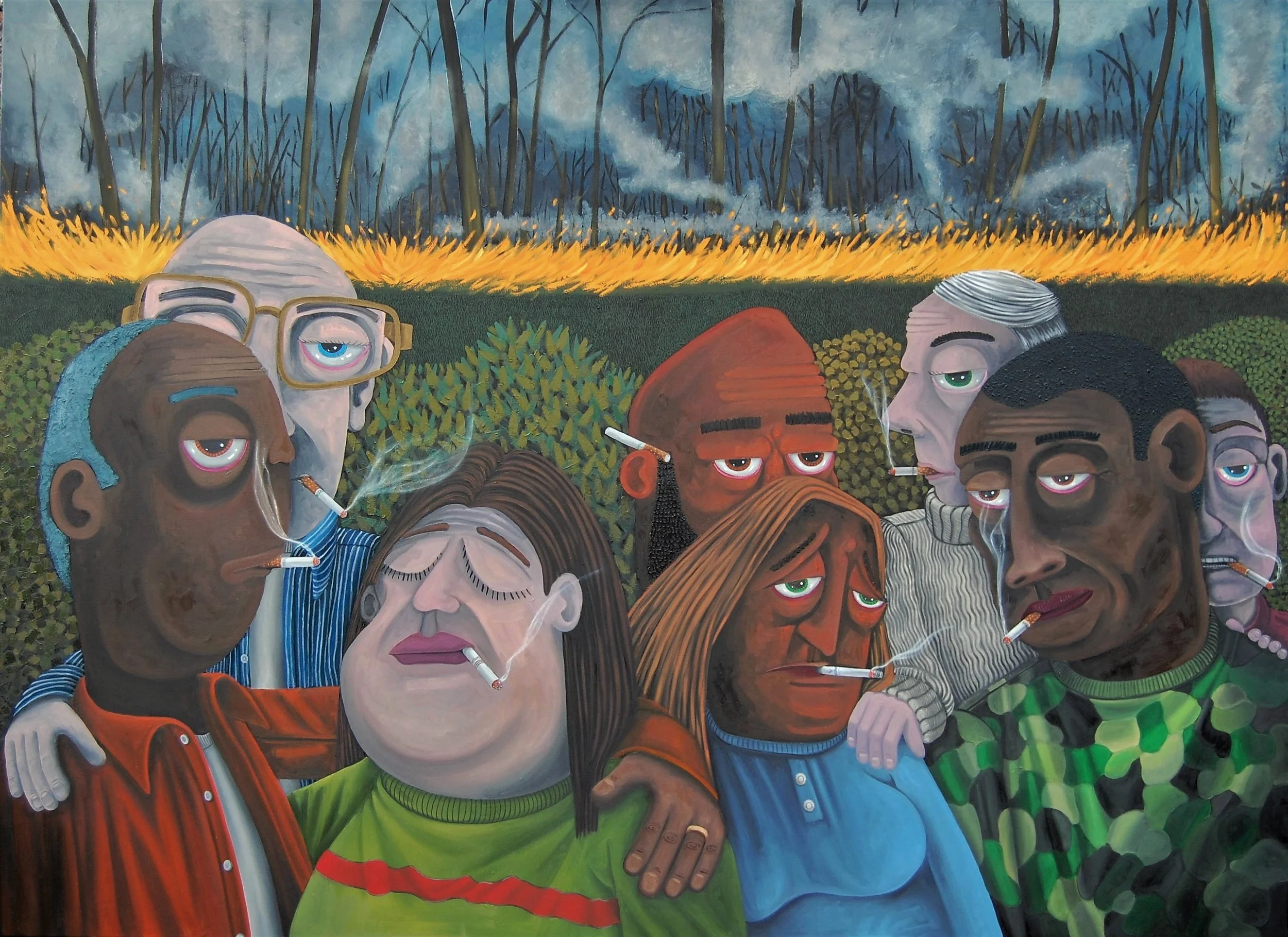
Smokers by Brian Cirmo