The Loss — By Asha Pandya
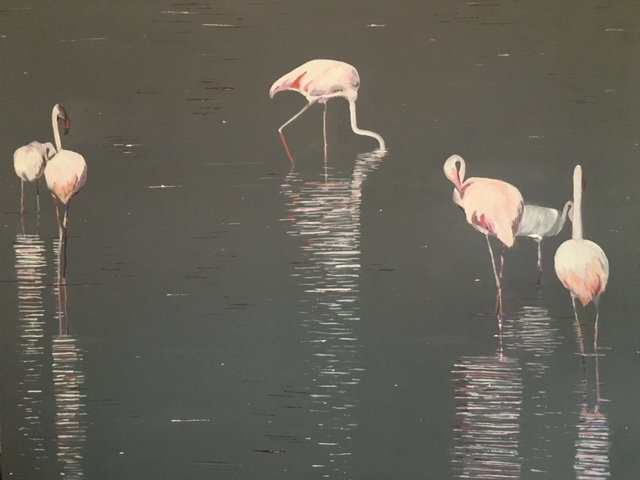
artwork by Brian McCafferty
I often talk to my grandmother’s ghost.
Unlike the woman she was in real life—fierce, feared by her children, grandchildren, daughters-in-law, and servants, yet loved just as fiercely—her ghost is remarkably benign. She appears without the fanfare you see in the movies – the sparks, the lightning, or eerie music. She comes and goes as she pleases, as she always did in life.
Dressed in her widow’s white cotton sari, her shaved head covered with the pallu, she sits upright on her throne—a simple charpai bed with her ever-present brass paan-box next to her. She seems to reign the space even though it is my house, my office, and my Pacific Ocean beyond my window.
The conversation, mostly in Gujarati, usually centers around her admonishing me for not becoming a doctor as I had promised. She holds on to a promise made by an eight-year-old even beyond the mythical river Vaitarani. I point out to her that amongst her twenty-three grandchildren, seventeen great-grandchildren, and four great-great-grandchildren, there are five doctors and three more in med school.
“But you are the one who got the Laddoo,” she says
I am not the oldest, nor am I the first male child. I am just a girl – her daughter’s middle child, and she told all of us that the Laddoo was mine.
The Laddoo wasn’t the sweet we ate on festive occasions, but the benign tumor in the crook of her arm, a remnant of the plague in which most of her village and her family perished.
We children, as we snuggled up in her lap at the nightly story-time, she took us into a world where the gods fought the demons and won – sometimes by sheer goodness and sometimes by trickery. Where lord Krishna played the flute and saved his playmates from the great serpent. Where Lord Vishnu transformed into the lovely Mohini and tricked the demon Bhasmasur into self-annihilation. We vied with each other to be closest to her, to her right arm, to caress the Laddoo, the tennis-ball-sized tumor, smooth, soft, squishy, and unwrinkled, unlike her arm.
Sometimes I argue with her, slipping between the familiar “Tu” and the more respectful “Tame”, sometimes even calling her “Devijee” in jest. More often, we trade insults in literary Gujarati, liberally sprinkled with Sanskrit, each trying to outdo the other. When I falter, I revert to my limited repertoire of English cuss words or, my specialty, mathematical insults.
What is this Firangi language of the Goras you are speaking?” She laughs at me.“Just because you live in America, you don’t have to show off Angrezi. Remember? You were the topper in Gujarati in your Board exam.” She scolds me whenever I struggle to find the words in my mother tongue. Gujarati was the language I thought in, the language I wrote poetry in, the language I lived in for the first eighteen years of my life. “Did that Madrasi mother-in-law of yours take away your Gujarati words along with all the dowry?”
I know better than to interrupt her with the reminder that I had forbidden my parents from giving any dowry. Meekly, I listen to her admonitions. After losing my mother, the last living member of my natal family, to Covid, this ghost became the only one I speak to in Gujarati.
The last time I saw her, about a month ago, I had an uneasy feeling. Something was odd, but I couldn’t put my finger on it. Then it hit me. My entire conversation with her was in English.
I haven’t seen her since.
Originally from India, Asha Pandya has lived in the San Francisco Bay Area since 1982. She is an aerospace engineer, a trained Indian classical dancer, an educator, and a lawyer. Her work reflects her diverse background and cultural experiences.