interview with Lindsey Pharr
Lindsey Pharr (she/her) writes from a crooked little cabin outside of Asheville, NC. She received her MFA in creative nonfiction from the Naslund-Mann School of Writing at Spalding University in Louisville, KY. Her work has appeared in Brevity, SmokeLong Quarterly, River Teeth, and elsewhere. For a full list of publications, please visit her website at www.lindsey-pharr.com
Lindsey Pharr writes with a feral tenderness, where the domestic and the surreal exist in uneasy proximity and transformation always feels just one breath away. Her work is charged with emotional volatility, desire, shame, hunger, memory, but rendered with a sharp, often uncanny precision that makes even the strangest turns feel inevitable. Her writing inhabits bodies and identities that are in motion, slipping between roles, selves, and temporalities, often with a dark wit that keeps sentimentality at bay. The result is writing that feels electric and destabilizing, intimate in its emotional access but wild in its imaginative reach.
We interviewed Lindsey about her piece, NASCAR Sunday, published in The Palisades Review. Read that story here and read her interview below.
TPR: NASCAR Sunday opens on Mother’s Day with a striking sense of anger and disorientation. What drew you to that emotional starting point?
Lindsey: While anger is an emotion that I try to distance myself from in everyday life, I sidle up real cozy with it when I’m writing. I’ve found that some of my strongest work has at least some anger in it. I woke up angry that particular Mother’s Day, the first after my father’s death. I usually send texts to all the mothers in my life on that day, but on this one the gesture rang hollow like most things did around that time. Instead, I was just pissed at the horribly unfair fact that we will lose everyone we love. I couldn’t shake it. And I guessed others might relate with that helpless anger, so I sent it out into the world.
TPR: There’s a strong sense of cyclical time in the piece, like races looping, and life split in two. Was that structure intentional from the start?
Lindsey: Well, memory itself is nonlinear. It eddies and swirls. And anniversaries, holidays, they’re definitely cyclical. It wasn’t intentional, that circular structure revealed itself as I wrote. Especially when I realized that a loop track’s start and finish line is the same point, that image really solidified what I was trying to say.
TPR: The imagery is incredibly tactile with sound, smell, and heat all feeling heightened. How do you approach building atmosphere at the sentence level?
Lindsey: My friend and teacher, Brian Lee Knopp, drove home the necessity of sensory-rich writing in my very first memoir class. Every one of the five senses needs to be present in a piece. I’m naturally focused on sensory details to a somewhat maddening degree all the time anyway, so they and the emotions they evoke are usually what comes through strongest when I write. And high spring is such a sensually explosive time of year that I couldn’t help but have those details suffuse every sentence. Then it’s a matter of deciding which senses to push back and pull forward into focus like in a painting or a photograph. And of course, scent is deeply connected with memory, so it became very acute in this piece.
TPR: Grief in this piece feels both immediate and accumulated over time. How did you think about writing loss without making it feel static or resolved?
Lindsey: I’ve lost a lot of loved ones in my life, and some of them I keep very close. They’re looking at me right now from a little altar next to my writing desk. I talk to them every day, pour them a little cup of coffee from the morning’s pot. Grief for me is not a static or resolved thing. It moves and shifts as I move and shift. Old grief comes singing out of the blue in the most unexpected moments. New grief isn’t singular, it brushes against other pain. Sometimes they become a chorus that moves in and out like a wave sweeping you out and washing you back ashore.
TPR: Your sentences feel very compressed but still expansive in meaning. What does your editing process look like when shaping a piece like this?
Lindsey: Thank you for saying so! I read out loud obsessively, and that really dials in the compression.
TPR: How do you decide what to leave unsaid, especially in a piece that deals with something as large as grief?
Lindsey: That’s a great question, because I sometimes struggle with feeling like I have to explain the whole thing when it’s simply too big to do so effectively. This piece initially had a whole other theme woven in about how grief seems to have become a buzzword lately. My partner at the time, my first and favorite reader, gave me feedback that it wasn’t really working. And he was right. So, I cut that thread and turned it into a separate piece.
TPR: When you’re writing about something deeply personal, how do you navigate the balance between emotional honesty and shaping the work for a reader?
Lindsey: Emotional honesty is my writing’s north star. If I stay true to it, my work will find the right reader at the right time.
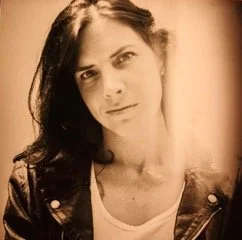
Lindsey Pharr